Nine out of ten disappointing readings are not the cards’ fault. They are a badly shaped question. The reader can only answer what you ask, and some questions have no answer in them at all — only a mood.
Bad questions, and why they fail
“What does the future hold?” — Nothing useful. There is no situation, no decision, no actor. The reading has to invent a subject, so it produces something that sounds profound and means nothing.
“Will he come back?” — Better, but it hands all the agency to someone else. You will get a yes/no and then feel exactly as stuck as before.
“Am I going to be okay?” — This is a request for reassurance, not information. The cards are not good at reassurance; they are good at describing what you are already doing.
What a good question looks like
Three ingredients: a situation you can name, a decision you actually control, and a time horizon.
- “Should I take the offer, given that it means moving in March?”
- “What am I not seeing about why this keeps happening at work?”
- “If I say no to this, what does the next six months look like?”
Notice all three have a “you” in them. That is the test: if the answer could be delivered to anyone in the same situation, the question was too general.
A good question and a three-card spread fit each other: one slot per ingredient. This is the shape the reader will fill in for you.
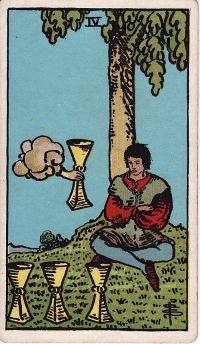 Four of CupsPast
 The Chariot rev.Present
 The WorldFuture
The one rewrite that fixes most questions
Take your question and add “and what should I do about it?”. “Will I find a new job” becomes “will I find a new job, and what should I do about it” — the second half is where the reading earns its keep.
Stop asking the same question twice
Repeating a reading until you get the answer you want is the most common way people ruin tarot for themselves. If a reading disappoints you, the useful move is to ask a different question — usually the one underneath, like “why did I want that answer so badly?”.
How to ask here
Type the question into the field on the home page, pick a spread, and press start. One sentence is enough. The reader will ask for nothing else, and it will not pretend to know things it cannot know — no death dates, no diagnoses, no guarantees about another person’s behaviour.